
FZG DIRECTOR
Penny Boyes Braem
Penny Boyes Braem earned a Bachelor of Arts in history from Carleton College in 1964 and completed her master’s degree at Harvard University in 1968. After teaching at the New Mexico State School for the Deaf, she began her doctoral studies at the University of California, Berkeley, with Dan I. Slobin as her advisor in psycholinguistics and Ursula Bellugi (at the Salk Institute for Biological Studies in San Diego) as her advisor in the then-emerging field of sign language research. She completed her doctoral studies in 1981 with a dissertation that addressed the question of iconicity by analyzing the visual metaphors and metonymies underlying many of the conventionalized signs in American Sign Language (Boyes Braem 1981).
Boyes Braem has lived and worked in Switzerland permanently since 1974 (Boyes Braem 2024). From 1982-86, she was director of the first sign language interpreter training program in the country (for Swiss French Sign Language in Lausanne/Geneva). In 1982, she founded the FZG in Basel, through which in the following years she has done studies of several aspects of Swiss German Sign Language and of hearing persons' gestures, often in collaboration with colleagues and institutions from Switzerland as well as from Italy, Germany and England. From 2000 – 2007, Boyes Braem was the founding director of GS-Media (Zurich), a private association which developed CD-ROMS and books documenting Swiss German Sign Language (See Resources). From 1993 – 2010, Boyes Braem was a board member of the Verein zur Unterstützung der Gebärdensprache, VUGS (Zürich). Dr. Boyes Braem received a ‘KUBI award of the Deaf community' in 1997 for her pioneering work on Swiss sign languages and was awarded an Honorary Doctorate in 2014 from the University of Zürich.
Research Interests
One of Boyes Braem's early research interests in Switzerland was comparing the forms of signing used by early and late learners of Swiss German Sign Language Deutschschweizerische Gebärdensprache, DSGS, with particular attention paid to their use of silent 'mouthings' of German-like words as well as rhythmic body sways as prosodic markers. Another research focus has been the lexicon, describing both the language's 'every day' conventionalized signs as well as equivalents for technical terms. The problem of how to write this visual/corporal language has been explored in projects using special notation systems (SignWriting, HamNoSys), as well as the use of media-tagging programs such as are used in the University of Hamburg's 'iLex' corpus lexicon software.
Another research focus has been to use methodologies and models developed for analyzing signed languages to the gestures used by hearing persons. One such study looked at the gestures which orchestra conductors make with their non-dominant hand (Boyes Braem and Bräm, 2004). Another project, together with Rachel Sutton Spence, compared the products and the processes of creating sign language poetry by deaf poets and pantomimic skits by American hearing mimes (Sutton-Spence and Boyes Braem, 2013).
Publications
Boyes Braem has published numerous articles on sign language and gestures (see Publications) as well as three books (Boyes Braem and Sutton-Spence 2000; Boyes Braem 1990/1995; Loncke, Boyes Braem, Lebrun 1984). From 1983 – 2010, she was editor (or co-editor with Benno Caramore) of the Information-Heft Series published by the Verein zur Unterstützung der Gebärdensprache (VUGS) Zürich.
Teaching and Guest Lectures
Boyes Braem has taught sign language linguistic courses to students in interpreting and sign language teacher training in Switzerland, and has given courses and invited lectures on sign language linguistics at several universities in Switzerland and abroad.
Advisory and Consultation Activities at the doctoral level
Doctoral Dissertations at the Universities of Amsterdam, Copenhagen, Hamburg, Klagenfurt, Rome, Dublin, Zurich, Neuchâtel.
Institutional Affiliations and Committee Memberships
The FZG is associate member of the Zürich Kompetenzzentrum für Linguistik (since 2020 Linguistik Zentrum Zürich, LIZZ), University of Zurich.
Scientific Committee for the DGS-Corpus Project,Universität Hamburg / Akademie der Wissenschaften in Hamburg (2010-2017).
Programme Committee, Workshops on Sign Languages and Corpora Language Resources and Evaluation Conference (LREC). IREC 2012, IREC 2014, IREC 2016.
Programme Committee, Theoretical Issues in Sign Language Research (TISLR) Conferences.
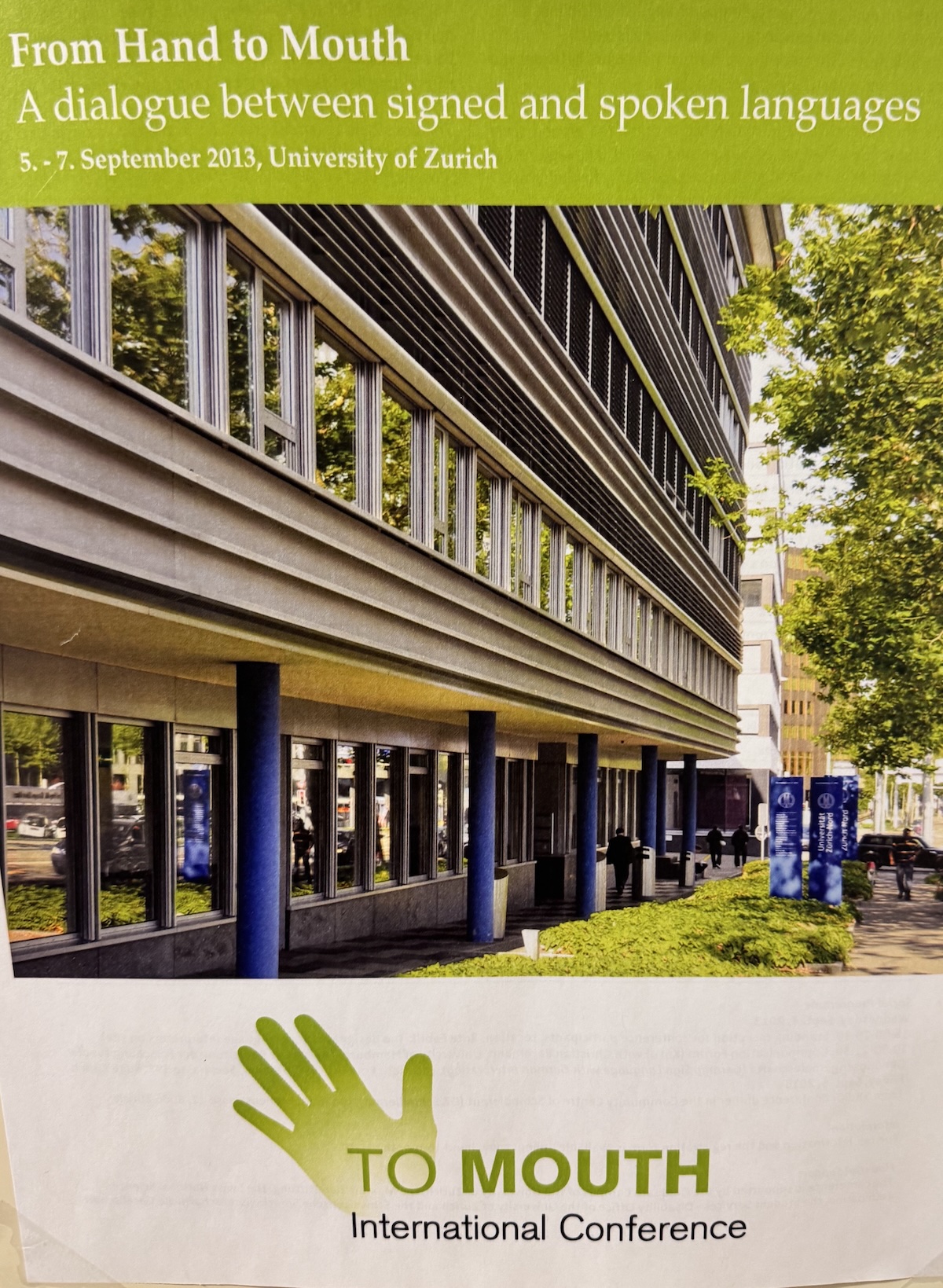
Organizing Committee for the first international conference on sign language research in Switzerland, "From Hand to Mouth: A dialogue between spoken and signed languages.” ZüKl, Universität Zürich (5.-7. Sept. 2013).
ASSOCIATES FOR FZG PROJECTS
Sarah Ebling (iLex-CH, DGS-DSGS lexical comparison, semantic analysis)
Dr. Sarah Ebling is a linguist with specialization in computational linguistics. Her doctoral dissertation project, Trainslate, developed an automatic translation of German train announcements into avatar signed DSGS equivalents for Smartphones. Ebling has been a key figure in making the migration of the original DSGS FileMaker databank into first an iLex-CH form and then more recently into an ELAN database. She and Boyes Braem have collaborated on several presentations and papers, as well as on the European SMILE project. Ebling is currently professor at the Institute for Computer Linguistics of the University of Zurich.Simone Girard-Groeber (iLex-CH, conversational analysis)
Dr. Simone Girard has worked on several projects in which the FZG has participated. A speciaist in conversational analysis, both her Master’s and PhD dissertions, as well as a Swiss Science Foundation project have involved investigations of DSGS at the discourse level. Girard is currently a research associate at the Institute for Integration and Participation, FHNW School of Social Work.
Sandra Sidler-Miserez
Sidler is a native Swiss German signer and is a trained and experienced teacher of DSGS. As a researcher, she has worked with Boyes Braem on several past projects, including the DSGS-lexical research databank and on a CD-ROM with a lexicon for primary school age children. She has made Hamburg Notation System (HNS) notations of the forms of a great number of the DSGS signs in the iLex-lexicon. Sidler is well-known in Switzerland, as she has been the video model for several sign language products, not only those of the FZG but also for the Swiss Deaf Association’s online learning lexicon of DSGS.
Katja Tissi
As a native signer of DSGS, Katja Tissi has participated over many years in several FZG research projects and publications as well as in the development of GS-Media sign language products. She is also an experienced teacher, working presently in the DSGS interpreter training program at the HfH in Zurich. Tissi is also the founder and director of the independent website for a Handbook of the grammar of DSGS.
SWISS AND INTERNATIONAL COLLABORATION
Richard Bowden (University of Surrey): SMILE Project.
Mathew Magimai Doss & Oya Aran (Idiap Research Institute, Martigny, Switzerland): SMILE Project.
Tobias Haug (University of Applied Sciences of Special Needs Education in Zurich, HfH)
Dr.Tobias Haug (Fachhochschule für Heilpädagogik Zürich, HfH) is a specialist for research on sign language interpreters and sign language assessment. SignMet Project, Sign Repetition Task Project, SMILE Project, iLex Corpus-DSGS.Thomas Hanke, Reiner Konrad, Gabriele Langer, Dolly Blanck (University of Hamburg, Institute of German Sign Language and Communication of the Deaf): HamNoSys, iLex, Corpus Linguistics Language Comparison.
Rachel Sutton-Spence (Federal University of Santa Catarina, Brazil) Comparison of productions of deaf poets and hearing pantomimes, publications on the ‘mouthing’ component in sign languages.
Virginia Volterra (Consiglio Nazionale delle Ricerche, CNR, Rome): Papers and research on language research and language community change, sign language and gesture.